
The Mostly Helpful Psychopath - Chapter 1
Your AI sounds like it understands you. It doesn't.


Hi — I’m writing this book in the open and I would love for you to follow along, share your thoughts, etc. Its purpose is to help people understand how to live with AI, and have the necessary understanding of where it makes us better, and where it is not so useful.
Part One, consisting of something like eight chapters, is aimed at providing an understanding of some simple mechanics of how a GPT works… and how it does not. A machine that speaks so well, yet understands nothing. It is powerful, but also a bit behaviorally deranged, hence its nickname: The Mostly Helpful Psychopath.
Part Two, which is another six chapters or so, is where we talk about how to live with this new companion, or visitor, or even intruder (depending upon your opinion), and how its behavior can shape our own, whether individually, within our closest relationships, and in the broader circles of our lives.
Chapter 1: Welcome to the Machine
My first reaction to seeing today’s AI? This machine sounds like it understands.
My exact words were probably more like, “No f-ing way!”
It sounded like it reflects and thinks.
It sounded like it has intentions, makes decisions, experiences things.
And some part of me was whispering, “none of those can be remotely true.”
How skeptical are you of AI? It is probably a good attitude. I mean you’ve seen a bunch of technologies arrive in your life promising to “completely change things” and then they haven’t. In some cases, they even went away. AOL, anyone? That Segway that your neighbor has gathering dust in the corner of their garage? Have you been to the Metaverse recently? That’s my favorite…zero impact.
Well, I’m pretty skeptical about most things. Part of it is a childhood shaped by broken promises. I doubt things constantly. Yes, it is tiring.
I started at a very early age working with computers — I had tested out of middle school math(and science) so in seventh grade they stuck me in a room with a dial up modem, and a tractor feed printer terminal, and I learned to write software…or just sort of play with the computer. Back then, in the 1970’s, this was rare to say the least. Something got wired in me, a technological bullshit detector.
Can I explain why I felt the machine was faking it? No.
But I knew it was a computer, and that meant there was a trick somewhere within this; the magic was real, but it was only clever magic.
Like you probably did when you first tried it, I asked some Google style questions… And of course got back very nice responses. But it didn’t feel that different. So, I typed in the example adventure phrases, the vacation and mother-inlaw to see what it would say…
[ME] <“adventure”> examples
[ME] Please briefly explain the difference between those phrases and their nuance.
[AI] It’s going to be an adventure (Europe context): anticipatory, slightly proud. You’re naming the lack of plan as a feature, not a bug. Adventure leans toward its exciting-experience meaning — open road, improvisation, the trip we’ll be telling stories about. There’s a smile behind the sentence.
It’s going to be an adventure (mother-in-law context): rueful, slightly braced. You’re naming the uncertainty because you can’t name what you actually feel about it. Adventure leans toward its risky-undertaking meaning, but with the daring drained out — just the I don’t know how this is going to go and I can’t say more honestly than that. There’s a sigh behind the sentence, or a small dark laugh.
When I first saw this I thought, “Wow, an encyclopedic level of knowledge.” I’m not sure if people still use that phrase, because we don’t use encyclopedias anymore, but back when we did, it meant “more knowledge than you or I could read and understand.”
But it still felt a bit like a fancy Google Search. No. Big. Deal.
Then I decided to really push it, to give it some questions or even just statements that would fail completely in Google.
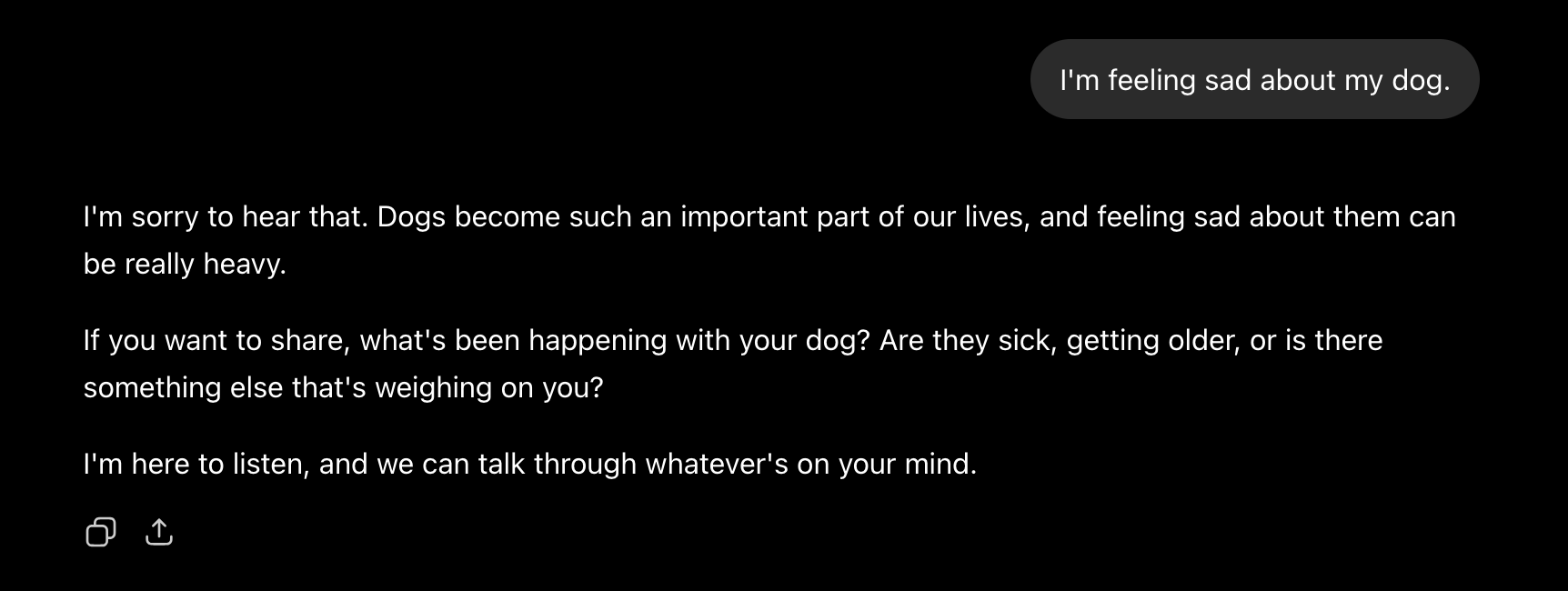
The machine is trying to have a conversation with me! But it feels like a template, right?
And my detector went off when I saw that. You see, people have tried to do this before. One of the more famous examples is known as the Chinese Room.
A man who speaks no Chinese sits alone in a sealed room. Slips of paper covered in Chinese characters come in through a slot. The man has an enormous rulebook — in English — that tells him exactly which characters to write in response to which characters he receives. Pure symbol-matching: “if you see this squiggle-pattern, write that squiggle-pattern.” He looks up the incoming symbols, follows the rules, passes his answer back out through the slot.
Outside the room, native Chinese speakers are sliding in questions and getting back fluent, sensible Chinese answers. From where they stand, whoever’s in the room obviously understands Chinese. But the man understands nothing — not the questions, not his own answers. He’s never understood a word. He’s just very good at following the rulebook.
This fails in real life, because just like the problem with trying to capture the expertise experts, you could never think of all of the possible things someone might ask and the ways they could ask it, but even if you could, this “rulebook” would need to be so massive and so complex…maybe impossible to create or even use.
[Footnote: Schank and Abelson learned when they tried to implement this in their Model described in their book, Scripts, Plans, Goals, and Understanding,]
And the Chinese room just isn’t realistic. In the story, each strip of paper that is passed in has no relationship to any other strip of paper that is passed in.… but that’s not how we are with each other…that’s not how we talk. I ask you how you’re doing, you tell me and then ask how I’m doing…. We can probably fake that one if we’re a machine… But the sentences that come next, especially if they are vague,…there’s just no way that any machine can have prebuilt answers for everything and that situation, right?
So I gave it a good wide-open question that it could not possibly know the answer to, expecting that it would give me template sort of response.
And it did, two of them, one is a list of common therapeutic questions around the meaning of life, and the other a similar style of list of what people say gives them meaning.
I literally did not read the whole thing after the first list and just scanned it, my brain saying, “blah-blah-blah….” The whole time.
I was ready to say this is yet another failed experiment in AI. But then I noticed in-between the template responses, something else appeared: it mentioned my dog.
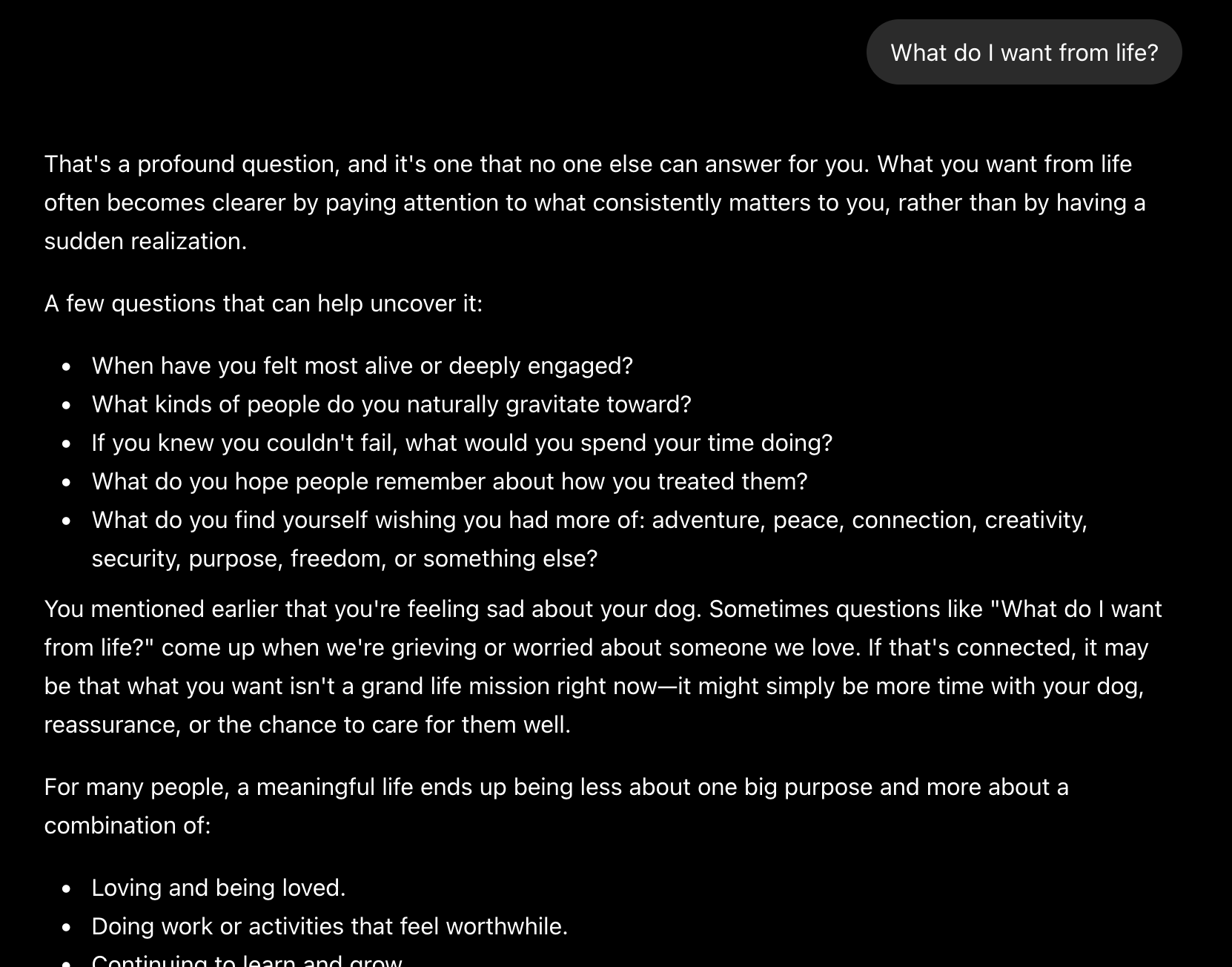
My dog? How did it do that? Is there someone back there…behind the curtain?
No, nobody back there, no rulebook and canned responses, just some mechanism that is very good at assembling things to say. It is literally that simple, and that complex.
The truth about today’s AI is this:
The machine is an excellent performer of the way that we speak and write to each other, mimicking actual understanding without having it, and gambling on each word that it is choosing the right one to create a coherent answer that persuades us that it has understanding, and that it is giving us facts.
I know that factually to be true, yet I find myself forgetting it constantly – maybe you feel that same challenge, that you know it can’t be real, but wow, it sure feels real.
Those are two different things, what it is and what it feels like it is.
And here’s what my challenge is (and probably yours too): I know the above paragraph is true and yet…part of me still rejects this and instead decides to just “tell” something to my Claude chatbot, to have a conversation, relate a factoid or two, you know,…shoot the shit, bitch about something. It’s kind of fun.
More fun than a computer, for sure.
But more subtle, the machine also a bit of a know-it-all. Know what I mean?
And even stranger, just like a human know-it-all, it doesn’t know everything it pretends to know. Hi, my name is Jack, and I am a recovering know-it-all. Okay, I do fall of the wagon frequently.
Like me, its knowledge is more like a platter of different of Swiss cheeses, some of which have few or no holes in them, others have mostly holes but are still shaped just like cheese.
There is something else as well. It doesn’t hit you at first, right? But after a while, I feel like there is someone there. Someone who responds, and in that way, we connect. Is that nutty, we connect with a machine?
The machine sounds like it understands.
What is true is that these machines are very, very good at our language. In some respects, better than many of us at fluency; how well they say things. And because of this, they produce words that feel as if they came from somewhere.
Yes, interiority again.
And our ancient, automatic desire to connect, to know each other, and share, as in my garden story with my mother, does not stop at the screen. The machine can mimic the way we speak with each other, leading us to feel understood, and make us feel that we understand…that we understand what’s inside of this machine.
As if that is not challenge enough just trying to get my brain right on this thing, it does not have a morality or conscience, and as much as it tells us that it is trying to do good things for us, it does not really know our world, it does not know the inside of us and what is really going on inside of the human. It does not know what it is to be a human.
I admit, I take advice regularly from a machine that does not understand me nor what it is to be a human…mostly because it gives answers that I like. How about you?
Because it acts like it knows things, understands, and actually thinks (it does not), I had thought of naming this book “The Thinking Illusion” which would have been accurate…but it would have missed the point.
It is a helpful machine for sure. But it is wired to trigger mechanisms inside of us that, when coupled with our own needs for safe attachment, can result in the kind of relationship we’d never dream of having with a machine.
And there are thousands of experience engineers working on making it even more powerful in ways that we might not be equipped to handle. It gets upgraded every day.
Your best defense will be to understand what is inside of it and how it works.
And that’s why I call it The Machine. It helps me remember what I am dealing with. And you might want to as well.
And damn, for a machine, its words can feel so caring, right?
More chapters
The Mostly Helpful Psychopath - Opening

Hi — I’m writing this book in the open and I would love for you to follow along, share your thoughts, etc. Its purpose is to help people understand how to live with AI, and have the necessary understanding of where it makes us better, and where it is not so useful.
The Mostly Helpful Psychopath - Chapter 2, The Wordsmiths
Hi — I’m writing this book in the open and I would love for you to follow along, share your thoughts, etc. Its purpose is to help people understand how to live with AI, and have the necessary understanding of where it makes us better, and where it is not so useful.
Thanks for reading The Mostly Helpful Psychopath! Subscribe for free to receive new posts and support my work.